
The 2026 B2B Buyer’s Guide to Custom Board Game Manufacturing: How to Audit Chinese Factories Without Leaving Desk
Margins in the board game box industry are shrinking. Between 2021 and 2025, raw material costs for paperboard and plastic components rose by 22%, while container shipping volatility added another 15–18% to landed costs for importers. Yet most sourcing failures don’t come from macroeconomics—they come from choosing the wrong manufacturing partner.
If you are a wholesaler, brand owner, or importer sourcing custom board games from China, the difference between a 3% defect rate and a 0.8% defect rate is not luck. It is process.
This guide is written from a 10-year manufacturing engineering perspective—straight into technical specifications, QC protocols, supplier comparisons, and real cost data.
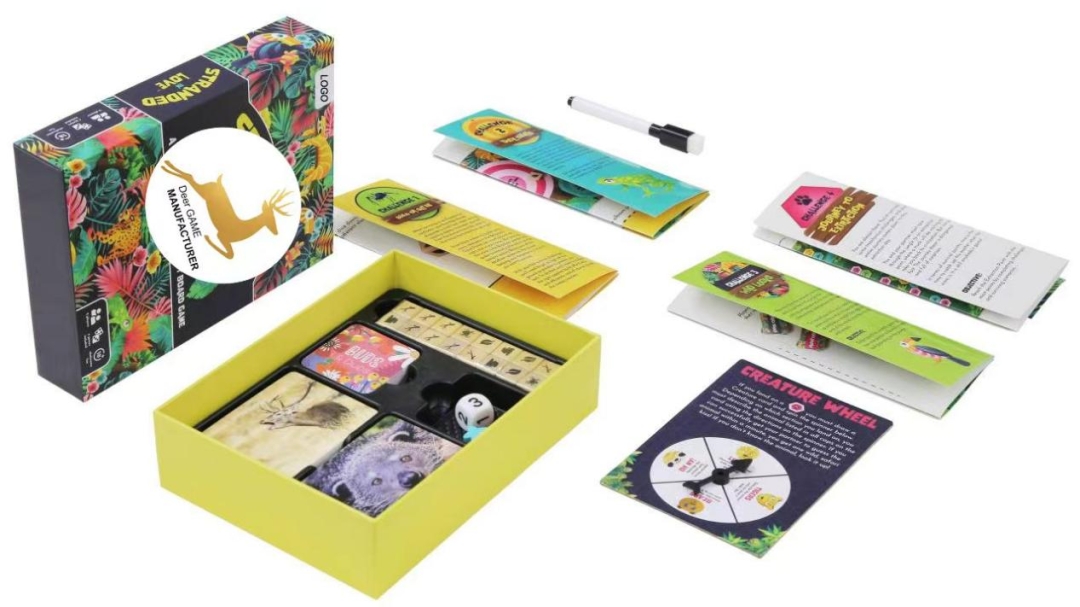
Buyer Pain Points: 3 Hidden Production Traps
Trap 1: Component Tolerance Drift
Your prototype fits perfectly. But production components shift by ±0.5 mm or more. The result: mismatched inserts and returns.
Industry standard: ISO 2768-1 requires ±0.2 mm for dimensions under 120 mm. Many budget factories operate at ±0.5 mm.
Trap 2: Certification Gap
You ask for “compliant materials.” The factory nods. Then your shipment is held at Rotterdam because the varnish contains prohibited photoinitiators.
Engineer’s Pro-Tip: Never accept verbal compliance. Demand test reports from ISO 17025-accredited labs.
Trap 3: The Sample-to-Mass Disconnect
Handmade samples look perfect. Mass production shifts colors by ΔE > 3, and card stiffness drops by 25%. Without in-process QC (IPQC), you won’t catch this until 50% of the order is finished.
Technical Specifications: Core Parameters
When evaluating custom board game factories, require documented specifications for these five parameters.
Cardstock thickness tolerance should be ±0.08 mm under ISO 534 for standard production. Premium suppliers achieve ±0.03 mm.
Board game tile flatness must stay within 0.5 mm bow per ISO 13660. High-end production targets 0.2 mm or less.
CMYK color deviation (ΔE) should remain below 4. For branded retail products, demand ΔE < 2 per ISO 12647-7.
Punchboard knockout force should fall between 2 and 4 kgf with ±0.5 kgf consistency.
Box corner crush resistance requires at least 12 kgf under ISO 12048 for e-commerce shipments.
Engineer’s Pro-Tip: For custom board games with frequent handling, prioritize 280 gsm cardstock with double-coated varnish. Cheap 250 gsm uncoated cards warp after 10 shuffles in humid environments.
Manufacturing & QC: IQC/IPQC/OQC Explained
IQC (Incoming Quality Control) : Paper moisture must measure 6–8% under ISO 287. Above 9%, blistering appears after lamination. Plastic components require Cpk ≥ 1.33.
IPQC (In-Process Quality Control) – Three critical checkpoints: after printing (register error ≤0.2 mm), after die-cutting (burr height ≤0.1 mm), and during assembly (box closure gap ≤1.0 mm).
OQC (Outgoing Quality Control) per ANSI/ASQ Z1.4: Critical defects at AQL 0% (safety), major defects at AQL 1.0% (wrong components), minor defects at AQL 2.5% (cosmetic issues).
Engineer’s Pro-Tip: Ask for IPQC records—not just the final report. A factory that cannot produce hourly IPQC logs does not have process control.
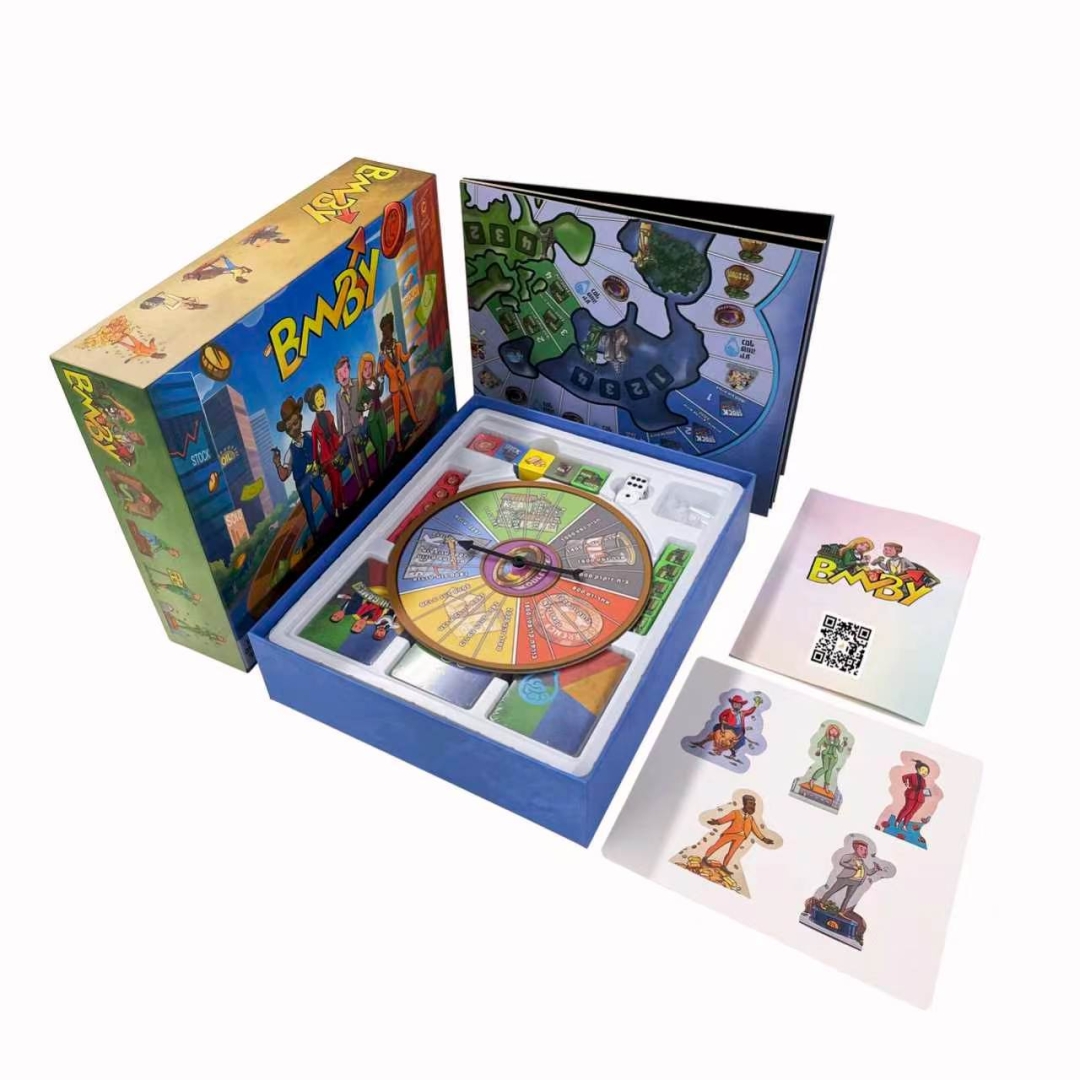
Supplier Comparison: Selection Framework
When asking “which Chinese custom board game factory is good,” evaluate across six criteria.
Years of experience (15% weight): An 18-year factory like Xiamen Brighting Industrial Co., Ltd. (established 2009) has survived multiple cycles. A four-year factory is still learning.
In-house QC team (15% weight): Three dedicated QC staff in a 50-person operation (30 production, 5 technical, 8 sales, 3 QC) provide real oversight. Factories with one shared QC cannot perform continuous IPQC.
Certifications (20% weight): Full EN71, ASTM F963, CPSIA, and REACH are non-negotiable. Trading companies with broker-dependent certificates pose serious risk.
Tooling & R&D (15% weight): In-house technical staff enable fast corrections. Outsourced tooling adds 10–15 days per revision.
On-time delivery (15% weight): 96% is reliable. Below 80% indicates systematic failures.
Transparency (20% weight): Factories offering live video tours before contract signing demonstrate real confidence.
Engineer’s Pro-Tip: A factory that refuses a live video tour of its QC line is hiding something.
Procurement Policy: MOQ, Lead Time, Payment
MOQ: Fully custom board games start at 1,000–3,000 sets. Component-only orders can go to 500 sets.
Lead time: Prototyping 7–12 business days. Bulk production 25–35 days after deposit. Sea freight China to US West Coast 18–22 days plus customs.
Payment terms: Standard is 30% TT deposit, 70% against B/L. For orders >$50,000, LC at sight reduces risk. Net 30 for established partners.
Customization: Embossing, spot UV, foil stamping, thermoformed inserts, and private label packaging are all available.
Engineer’s Pro-Tip: For private label development, require a first article inspection (FAI) on the first 10 production units—not the prototype.
Real-World Case Studies
Case 1: German Wholesaler – Defects from 5.2% to 1.1%
A wholesaler distributing 200,000 units annually switched to a factory with IPQC at four checkpoints. Result: 79% drop in returns, saving €47,000 per year.
Case 2: US Board Game Brand – Tooling Costs Cut 32%
Eight custom punchboard dies quoted at $12,800. Switching to a factory with in-house technical staff (1,500 m², 5 engineers) reduced tooling to $8,700.
Case 3: UK Importer – Avoided $22,000 Detention
Previous factory provided fake EN71 certificates. Customs found elevated boron levels. New partner with 18 years experience and ISO 17025 lab reports pre-tested every lot, avoiding $22,000 in destruction fees.
FAQ
Q1: How do I verify which Chinese custom board game factory is good before visiting?
Request three documents: ISO 9001:2015 with “board game manufacturing” in scope, three months of IPQC logs, and a recent third-party audit (SGS or Bureau Veritas).
Q2: What is the real cost difference between OEM and ODM?
OEM requires 3,000 units but delivers 15–20% lower per-unit cost. ODM can go to 1,000 units but has higher unit pricing due to design royalties. For volumes under 5,000, ODM often has lower total project cost.
Q3: How long does custom board game prototyping take?
Functional prototype (fit only): 5–7 days. Fully printed prototype: 12–15 days. Corrections add 3–5 days.
Q4: Which certifications are mandatory for Europe vs. US?
Europe: EN71-1,-2,-3 and REACH SVHC. US: ASTM F963, CPSIA, and California Prop 65.
Q5: Can a 50-person factory handle large orders?
Yes. A 50-person factory with 30 production, 5 technical, 8 sales, and 3 QC can produce 10,000 sets per day across 6+ lines. Employee count matters less than process discipline.
CTA: Engineer-to-Engineer Support
Stop guessing. A 10-minute call with a sourcing engineer can identify the right production fit for your custom board game project.
Xiamen Brighting Industrial Co., Ltd. offers 18 years of custom board game manufacturing, in-house prototyping, OEM/ODM, private label development, and full certification support (EN71, ASTM, CPSIA, REACH). Live video production audits available before you commit.
Request your free manufacturing feasibility review → Contact the engineering team directly.
Media Contact
Company Name: Xiamen Brighting Industrial Co., Ltd.
Contact Person: Alice Lu
Email: Send Email
Country: China
Website: https://www.deergm.com


